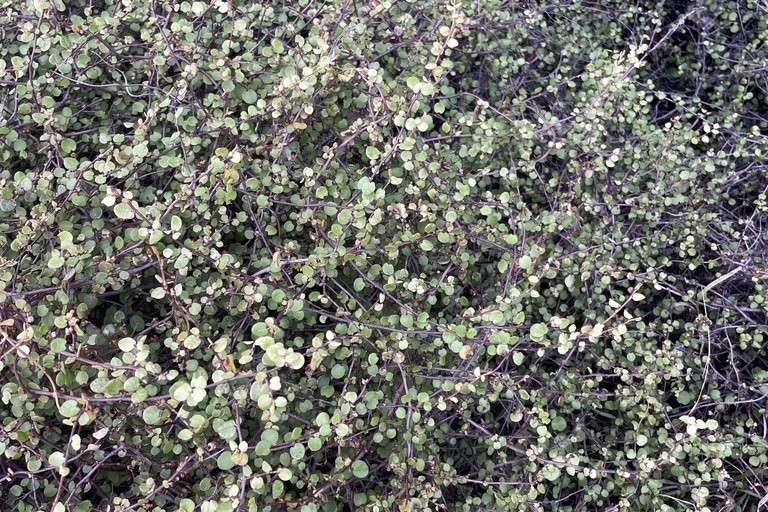
Pōhuehue (Muehlenbeckia complexa) is one of 50 species of shrubs known to be divaricate, with interlaced branches and a reduced number of leaves. This trait is more or less unique to New Zealand, with very few divaricate species being found elsewhere in the world. Pōhuehue forms a dense, thick mass of interlaced branches. The stems are slender and creep or twine over other plants or rocks, without support, it will climb upon itself, forming thick and dense prostrate masses. When it occurs near the shore, it frequently assumes cushion form.
A wide variety of insect species are associated with pōhuehue. It is also a food source for birds such as tūī, and bellbird which also feed on the buds and leaves. As a early coloniser it helps with soil erosion, and supresses weed species.